Recession risks push oil demand down - analysts expect $100 per Brent in 2 half of the year
17:43 22.07.2022 5580
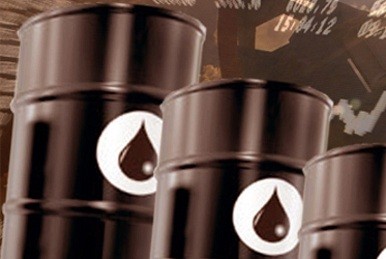
Fears about a recession in the global economy, which may come due to the crisis in the energy market, dropped Brent prices by 7% during July. To date, the cost of a barrel has fallen below $103. Industry analysts are convinced that quotes will fall by a few more dollars and remain at this level until the end of 2022, Interfax reports.
To date, the main threat to oil prices are the risks of a recession in the global economy. Over the past months, experts have been predicting it against the backdrop of a significant increase in the cost of energy products, provoked by the sanctions confrontation and the subsequent redistribution of supplies in the global market.
“A drop in demand would lead to a decrease in prices in the medium term, but we have a global regulator - OPEC+. It will simply reduce production quotas if demand sags significantly,” Alexander Frolov, deputy director general of the National Energy Institute, said.
US President Joe Biden visited Saudi Arabia last weekend. As a result of the talks, the American side announced agreements with the kingdom, which will assume obligations to maintain balance in the world oil market. In particular, the United States "welcomed the 50% increase in production levels compared to what was planned for July and August".
An increase in supply on the market would further push oil prices down, however, according to Frolov's calculations, in the short term the kingdom will be able to bring an additional 85,000 barrels per day to the market. "This is an extremely small value against the backdrop of Russia's lagging behind and short deliveries to the market from such countries as, for example, Libya," Frolov explained.
Analysts polled by Interfax agree that the price of Brent in the second half of the year will be about $100/bbl.
In addition to the recession and the subsequent deterioration in demand, a new wave of the pandemic could affect the price correction. The market has already experienced a decrease in demand from China due to the introduction of severe restrictions on the coronavirus. It is possible that similar measures may be introduced in other countries, given the observed increase in the incidence. In particular, WHO this week stated a new wave of COVID-19 in Europe and called for prompt action.
Analysts at Bank of America in the base scenario see the cost of Brent in 2022 at $102/bbl, but at the same time they allow the price to fall to $75/bbl. during a recession or growth to $150/bbl. in the event of new European sanctions against supplies from the Russian Federation.
The worst-case scenario was voiced by JPMorgan: oil prices could "fly into the stratosphere" - up to $380/bbl. This is possible if Russia's production is reduced to 5 million bpd. According to analysts, Moscow can take such a measure without undue harm to its own economy if Western countries impose a ceiling on oil prices from the Russian Federation.
Analysts of the American Citigroup see the other extreme, who predict that in the event of a recession, prices will fall to $65/bbl. This forecast is based on a scenario that excludes intervention by OPEC+ countries in the market and assumes a decrease in investment in the oil and gas industry, the bank notes in a report.
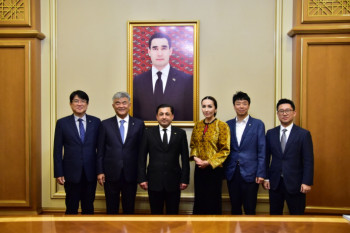
Daewoo E&C strengthens strategic ties with Turkmenistan
Daewoo E&C Chairman Jeong Won-ju visited Turkmenistan from June 26 to 30 to discuss new business opportunities and strengthen the company's presence in the Central Asian market, the company said in a statement on July 1.
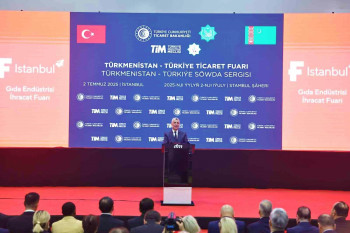
Turkmenistan's export potential presented in Istanbul
The exhibition of export goods of Turkmenistan opened in the Istanbul Exhibition Center. The event, which will last from July 2 to 5, has become a clear evidence of the development of bilateral cooperation, actively supported by the heads of state, Orient reports (Orient Link: https://orient.tm/ru/post/87213/turkmenistan-stambul-vystavka-eksport).
Chairman of the Halk Maslahaty of Turkmenistan outlined the main features of the country's economic development
Speaking at a meeting of the Halk Maslahaty of Turkmenistan, National Leader of the Turkmen people Gurbanguly Berdimuhamedov emphasized that the key factor in the sustainable advancement of any country is economic growth, TDH reports.

Turkmenistan and the UK are ready to develop trade and economic cooperation in priority areas
Topical issues on the bilateral agenda were discussed at the talks between the Foreign Minister of Turkmenistan Rashid Meredov and the Parliamentary Deputy Secretary of State of the British Foreign, Commonwealth and Development Department, Minister Leo Doherty, who arrived in Ashgabat on a working visit. This was reported on the website of the Foreign Ministry of Turkmenistan.

The Democratic Party of Turkmenistan nominated Serdar Berdimuhamedov as a candidate for the post of President of the country
Vice-Chairman Serdar Berdimuhamedov has become the first candidate for the post of head of state in the upcoming early presidential elections in Turkmenistan. His candidacy was nominated and unanimously supported at the IX Extraordinary Congress of the country's Democratic Party, held on Monday.