
Program Manager of the Green Central Asia Project, GIZ, Dr. Caroline Milow
12:32 27.06.2025 3119
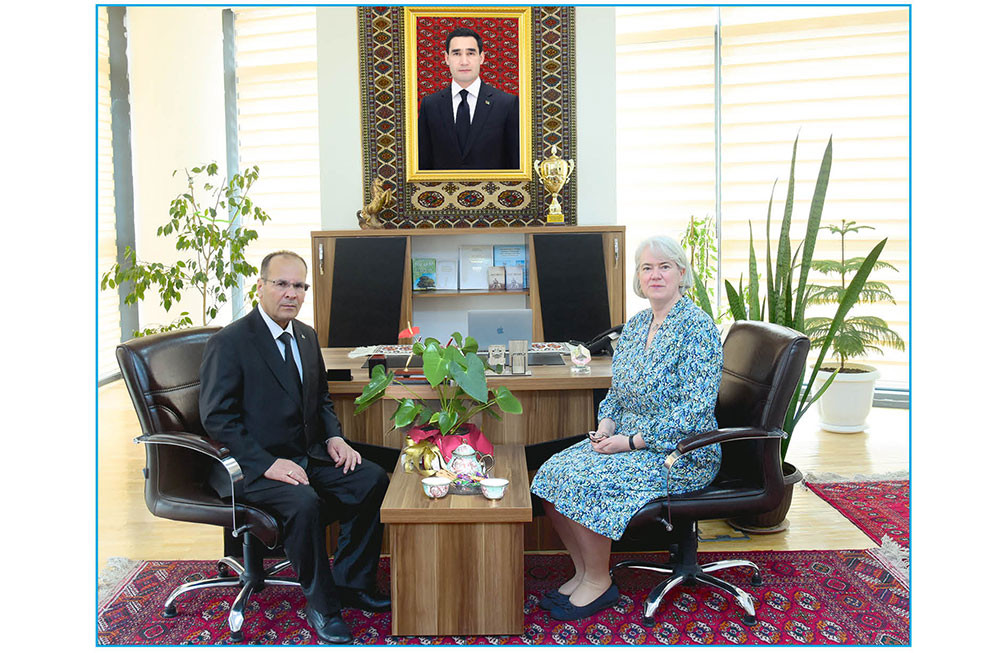
Program Manager of the Green Central Asia Project, GIZ, Dr. Caroline Milow Head of the Green Central Asia Programme, GIZ, Doctor Karolina Milow: “Cooperation with Turkmenistan is a contribution to a common climate future”.
Energy issues today are inextricably linked with climate change. This requires a transition to sustainable energy, the introduction of clean technologies and the development of alternative energy sources. Combatting global warming is impossible without reducing emissions of greenhouse gases such as methane and carbon dioxide. Turkmenistan is actively working in this direction: in 2012, the National Climate Change Strategy was adopted and then updated in 2019, and the country joined the Paris Agreement and the Global Methane Pledge.
For a more detailed discussion of the work carried out in this area by Turkmenistan in cooperation with the European Union, we invited Doctor Caroline Milow, Program Manager of the German Society for International Cooperation (GIZ).
UU: Dr. Milow, please tell us about the key areas of your program in Turkmenistan.
CM: Since 2019, with the opening of the Delegation of the European Union to Turkmenistan, there has been a significant increase in business and official contacts between the EU and Turkmenistan, which confirms the mutual interest in a sustainable partnership. Currently, the Project “EU for Green Development of Turkmenistan: Political Dialogue and Climate Action for 2024–2028” is being successfully implemented. This project is funded by the EU and the German Federal Ministry of Foreign Affairs and is being implemented within the framework of the Green Central Asia II Program. The project budget is 4.77 million euros, and the project partners are the Ministry of Foreign Affairs of Turkmenistan, the Ministry of Energy, the Türkmengaz State Concern and the Ministry of Environment Protection. The project will be completed in March 2028.
UU: How do you assess the role of Turkmenistan in solving global environmental problems?
CM: Turkmenistan takes an active position in the international climate arena. It was the first in the region to approve the Regional Strategy for Adaptation to Climate Change and also proposed the creation of a Regional Climate Technology Center under the auspices of the UN. An important step was the approval of the national contribution under the Paris Agreement, in which Turkmenistan committed to reduce greenhouse gas emissions by 20% by 2030 compared to 2010. Also, within the framework of COP 28 in Dubai, the country joined the Global Methane Pledge.
UU: Dr. Milow, how do you think Turkmenistan is implementing the tasks to reduce emissions in the energy sector?
CM: The country is achieving significant progress in utilizing associated petroleum gas and reducing losses during natural gas transportation. Turkmenistan seeks to integrate environmental standards into long-term energy infrastructure modernization projects. It is important that the country focuses on energy efficiency, renewable energy sources and the reduction of the carbon footprint. Gas is considered not only as an export resource, but also as an important element in the transition to cleaner energy. Strategies such as the National Climate Change Strategy and the Law “On Renewable Energy Sources” confirm this course.
Turkmenistan is actively working to reduce methane emissions, which is confirmed by the adoption of the 2025–2026 Roadmap, aimed at achieving the goals of the Paris Agreement and other international climate commitments. We support these efforts through the introduction of international energy efficiency standards and technologies and facilitate political dialogue with the EU.
UU: Which regional initiatives are particularly important in the context of sustainable development in Central Asia?
CM: The adopted Regional Strategy for Adaptation to Climate Change in Central Asia is an important step towards coordinated action. It unites the efforts of Kazakhstan, Kyrgyzstan, Tajikistan, Turkmenistan and Uzbekistan in areas such as water management, energy and land use. This is a true example of international cooperation for the benefit of a sustainable future for the region.
UU: How does GIZ support the development of green technologies in Turkmenistan?
CM: We are actively working to promote renewable energy sources and energy efficiency. As part of our project, we organized a youth climate conference in Mary, at which energy conservation and the use of renewable energy sources were discussed. This event inspired young people to develop an information strategy to raise awareness of climate change. We also supported the establishment of the Information and Analytical Center at the Natural Gas Research Institute of the Türkmengaz State Concern, which was an important step towards the introduction of advanced technologies and scientific research in the field of gas energy.
UU: You have recently announced a competition of articles on green energy issues, which has caused great interest in the country. What is its purpose?
CM: This competition is being held within the framework of 2025 declared the International Year of Peace and Trust in order to popularize sustainable development topics among a wide audience. We are holding it jointly with the Türkmengaz State Concern and the editorial boards of the Nebit-Gaz Newspaper and the Ussatnews Electronic Newspaper.
Participants are to submit articles with original ideas and practical proposals. The winners of the competition will receive valuable prizes provided within the framework of our project. This format allows not only identifying talents, but also stimulating public interest in climate and sustainable energy issues.
UU: Doctor Milow, thank you for the interview. On behalf of our numerous readers, we wish you every success in your further work on the sustainable development of Turkmenistan.
CM: Thank you. I am confident that the joint efforts of all parties will contribute to the creation of an environmentally friendly and sustainable future for both Turkmenistan and the entire Central Asian region.
Ussa USSAYEV,
Editor-in-Chief of the Nebit-Gaz Newspaper

Neon industry can bring large incomes to Turkmenistan, - expert
The well-known Turkmen scientist, expert and doctor of technical sciences Allaberdy Ilyasov considers the possibility of producing the chemical substance of neon in Turkmenistan very promising. This is reported by CentralAsia.news.

Participation of the GECF Secretary General in the TEIF 2025 forum will be another step in the development of energy partnership
Active preparations are underway for the International Forum on Attracting Foreign Investments into the Economy of Turkmenistan (TEIF 2025), which will be held on April 23-24, 2025 in Kuala Lumpur, Malaysia. The number of registered delegates to the upcoming industry forum, organized by the State Concerns "Turkmengas" and "Turkmennebit", the Chamber of Commerce and Industry of Turkmenistan in partnership with the Turkmen Energy Forum Economic Society, is growing every day.

Various types of fuel and polyethylene sold at exchange auctions
Last week, 36 transactions were registered at the auctions of the State Commodity and Raw Materials Exchange of Turkmenistan.

Turkmenistan will come up with initiatives in the field of energy at the UN General Assembly
At the 77th session of the United Nations General Assembly, which starts in New York in a few weeks, Turkmenistan will propose a number of initiatives, including in the energy sector. This is reported by the Ministry of Foreign Affairs of Turkmenistan.

Further expansion of cooperation between Russia and Turkmenistan meets the interests of both countries, - Mikhail Mishustin
Russian Prime Minister Mikhail Mishustin is convinced that further expansion of cooperation between Russia and Turkmenistan fully meets the interests of both countries. Mishustin wrote about this in a letter to the President of Turkmenistan Serdar Berdimuhamedov, in which he congratulated the Turkmen leader on the holiday of Novruz.