
Green energy that brightens our future
21:52 12.11.2025 2820
As global experience shows, the efficient use of fuel and energy resources and the successful resolution of this problem are of paramount importance not only for the future development of society but also for the preservation of the natural environment – the biosphere. One of the most promising areas in this field is the application of new energy-saving technologies using alternative, renewable energy sources, which is one of the key objectives.
Solar power plants, which utilize solar energy, one of the primary sources of green energy, to convert it into electricity, are currently rapidly developing. Every year, the Sun’s energy accumulates in inexhaustible reserves, exceeding the reserves of all fossil fuels (coal, oil and natural gas) stored in the Earth’s crust. Solar energy, also considered a critical solution for environment protection, is essential in areas such as reducing dependence on fossil fuels, easing the burden on limited resources and maintaining the health of the planet.
It is also worth noting that in recent years, the share of solar energy among renewable energy sources has increased. Solar power facilities: the installation of large numbers of solar panels to generate electricity and then to supply it to consumers. An example is the Abu Dhabi Solar Center (UAE), one of the largest in the world.
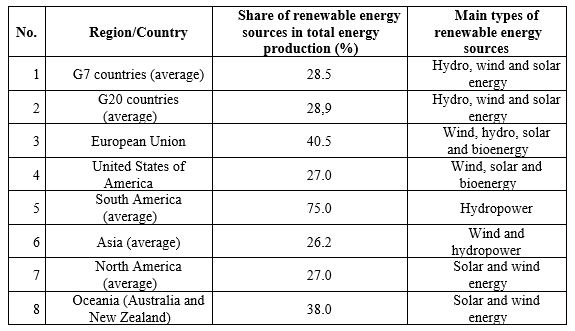
Wind turbines: the construction of wind farms, both onshore and offshore, to generate wind energy. For example, the UK is actively developing its North Sea Wind City. The share of renewable energy in total energy production in most countries currently varies significantly. This is due to the varying potential of renewable energy sources in different countries and regions.
Table 1
Share of renewable energy sources in total energy production in different regions (countries) (2023)
Solar energy is effective for reducing energy costs, ensuring uninterrupted power supply, generating electricity or heat and powering household appliances and lighting systems. Accordingly, this energy source is also environmentally friendly. Among renewable energy sources, solar energy is considered the most powerful. Our sunny country offers favorable conditions for the development of solar energy. After all, over 300 of the 365 days a year are sunny, with 12-14 hours of daylight a day. Solar energy is one of the most convenient and cost-effective renewable energy sources.
Currently, solar power plants are capable of generating electricity or heat on both sunny and cloudy days. Solar energy is recommended not only in regions with abundant sunshine but also in areas where the average number of sunny and cloudy days is roughly equal. In these cases, better results can be achieved by using more advanced heating equipment. Thanks to innovations in quantum physics and nanotechnology, the efficiency of solar panels can be improved, and the amount of energy they generate can be increased severalfold. Utilizing advances in engineering and technology and continuing research into solar energy are among the positive factors in unlocking the potential of our country’s energy sector and ensuring its continued economic development.
Advantages of solar energy are the following:
— Solar energy is free;
— It can provide electricity to rural communities in the heart of the Karakum Desert, at the foot of the mountains;
— It reduces the environmental impact of energy generation.
— Solar-powered devices do not pollute the environment.
Solar energy is generated using natural semiconductors. One such semiconductor is silicon. Turkmenistan has enormous silicon resources. The Karakum sands contain tiny particles of this silicon. Using complex processes, single crystals are grown from silicon. They are then cut into wafers and converted into solar-grade silicon 0.2–0.4 millimeters thick.
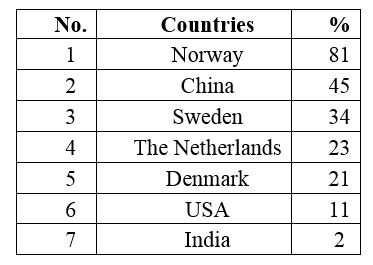
The mass production and sale of Tesla vehicles exemplifies the widespread use of electric vehicles to reduce carbon dioxide (CO2) emissions. For the widespread use of eco-friendly vehicles, it is necessary to create an infrastructure that meets certain requirements. Examples of such conditions include the availability of charging stations for eco-friendly vehicles and repair shops. Creating and developing these conditions is a challenging task, yet the share of eco-friendly vehicles in the total number of cars sold worldwide continues to grow.
Table 2
Share of environmentally clean cars in total car sales in different countries (2023)
The main difference between electric vehicles and internal combustion engines is that they are powered by batteries, which reduces environmental emissions. Charging electric vehicles from charging stations equipped with solar panels is considered an important solution. Excess energy generated during the day can be stored in batteries and used at night as needed.
Installing solar panels in the parking lots of institutions, enterprises, residential complexes and bus stops will be cost-effective.
Developing alternative energy to ensure sustainable economic development allows not only diversifying fuel and energy resources but also reducing carbon dioxide (CO2) emissions and giving a powerful impetus for the introduction of advanced innovative technologies in industry.
The city of Arkadag is built entirely according to the smart city conception, taking into account environmental requirements. A smart lighting system, modern digital services and smart trash bins have been installed. It is worth noting that on May 17 of the current year, with the participation of the National Leader of the Turkmen people Hero-Arkadag, a Memorandum of Understanding was signed between the State Committee for the Construction of the City of Arkadag under the President of Turkmenistan and the Asian Development Bank. Solar panels will be installed at the railway and bus stations planned for construction as part of the city’s second phase. The solar panels will ensure uninterrupted power supply to the control and lighting systems at the stations. The use of solar panels in electric vehicles and at stations is part of sustainable development, energy security and environmental friendliness. This project will not only ensure energy efficiency but will also allow comprehensively introducing innovative technologies and providing society’s future with clean energy.
Gurbanmuhammet
HALLIYEV,
a student at the
Civil Service Academy under the President
of Turkmenistan

Neon industry can bring large incomes to Turkmenistan, - expert
The well-known Turkmen scientist, expert and doctor of technical sciences Allaberdy Ilyasov considers the possibility of producing the chemical substance of neon in Turkmenistan very promising. This is reported by CentralAsia.news.

Method for Obtaining Oxygen from Carbon Dioxide Has Been Developed in China
Scientists from Nanjing University in China have made a breakthrough in oxygen production technology by developing a method for extracting it from carbon dioxide (CO2). The results of the study were published in the scientific journal Angewandte Chemie International Edition (ACIE).

Various types of fuel and polyethylene sold at exchange auctions
Last week, 36 transactions were registered at the auctions of the State Commodity and Raw Materials Exchange of Turkmenistan.

The President of Turkmenistan congratulated his compatriots on the Night of Gadyr Gidjesi
President Serdar Berdimuhamedov sent a congratulatory message to the people of Turkmenistan on the occasion of the sacred Night of Omnipotence - Gadyr Gidjesi, symbolizing the prosperity and spiritual purification of the month of Oraza.

Participation of the GECF Secretary General in the TEIF 2025 forum will be another step in the development of energy partnership
Active preparations are underway for the International Forum on Attracting Foreign Investments into the Economy of Turkmenistan (TEIF 2025), which will be held on April 23-24, 2025 in Kuala Lumpur, Malaysia. The number of registered delegates to the upcoming industry forum, organized by the State Concerns "Turkmengas" and "Turkmennebit", the Chamber of Commerce and Industry of Turkmenistan in partnership with the Turkmen Energy Forum Economic Society, is growing every day.